What Is Beauty for Plato?
In short. For Plato, beauty (to kalon) is an objective, unchanging Form, not a matter of taste. How the Symposium, Phaedrus and Republic each treat it.
Beauty, for Plato, is a Form: a single, unchanging reality that every beautiful thing shares in, not a quality that depends on who is looking. A face, a law or a piece of music can be beautiful, but each is beautiful only because it participates in Beauty itself, which is beautiful always and in every respect. Plato works this idea out across several dialogues rather than one, and each gives it a different edge: the Symposium makes it the goal of desire, the Hippias Major tests and fails to define it, the Phaedrus makes it the one Form we can still see, and the Republic makes it the mark separating the philosopher from the crowd.
Is beauty objective or in the eye of the beholder for Plato?
Objective. This is the flattest disagreement between Plato and the common modern slogan “beauty is in the eye of the beholder.” For Plato, calling something beautiful is a claim that can be true or false, the way calling something equal or larger can be true or false. Individual judgments vary and get things wrong, but they are judgments about a real standard, not reports of private taste.
The clearest statement of this is in the Symposium, where the priestess Diotima describes Beauty itself as something that “always is, and neither comes to be nor passes away, neither grows nor shrinks” (211a), and, crucially, is not “beautiful in one respect and ugly in another, or beautiful at one time and not at another, or beautiful in relation to one thing and ugly in relation to another, or beautiful here and ugly there, as if beautiful to some people and ugly to others” (211a–b). Ordinary beautiful things fail every one of these tests: a face beautiful at twenty is not beautiful at eighty, a piece of music beautiful in one style sounds wrong in another. Beauty itself fails none of them. That is what makes it a Form rather than just a very good example of a beautiful thing, a distinction covered more generally in what Platonic idealism means.
What is the ladder of love in the Symposium?
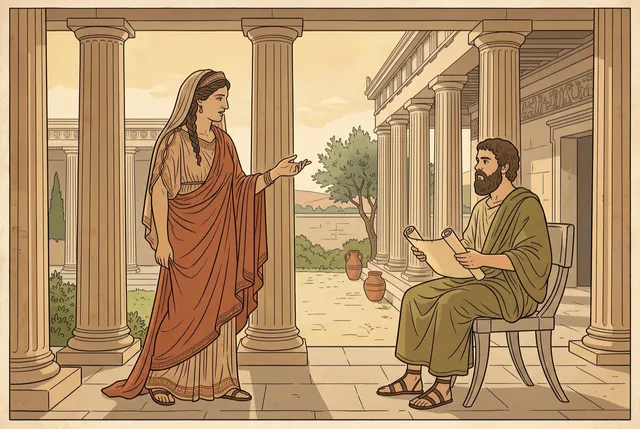
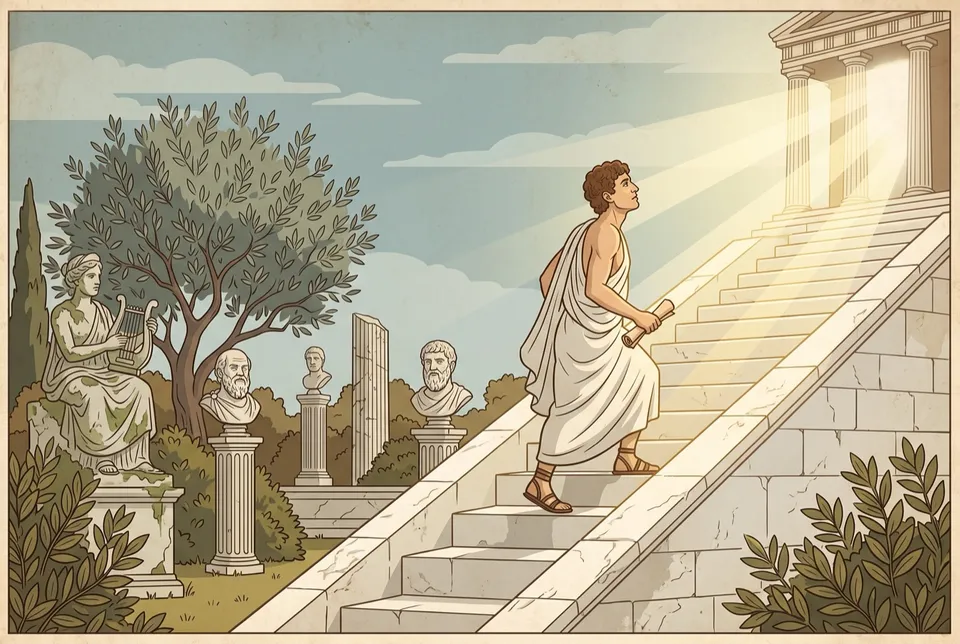
The Symposium’s account of beauty is delivered inside a speech about love, because Plato thinks desire for beauty is what starts a person climbing toward it. Diotima describes the ascent as a ladder (210a–212a). It begins with loving one beautiful body, then generalises to loving the beauty found in all beautiful bodies, then rises to loving beautiful souls, then to the beauty in laws and institutions, then to the beauty of the sciences and forms of knowledge, and finally arrives at a single science, “the science of this very Beauty” (210d), which is the direct sight of Beauty itself.
At the top, Diotima says, the initiate sees something “wonderful in its nature,” the very thing all the earlier beautiful things were leading toward (210e). Reaching it is described as the point at which a life becomes worth living for a human being (211d). This ascent is the backbone of what Platonic love actually means in Plato’s own vocabulary: not affection without physical desire, but desire redirected, stage by stage, from a body to the Form. Diotima herself, the figure who delivers the whole speech, is discussed at more length elsewhere, and the structure of the dialogue as a whole is unpacked in our survey of the Symposium.
Why do the Hippias Major’s definitions of beauty fail?
Before Plato gives his positive account in the Symposium, an earlier dialogue shows how hard the question is to answer directly. In the Hippias Major, Socrates asks the sophist Hippias a plain question: not what things are beautiful, but what the beautiful itself is. The dialogue’s authenticity as a genuine work of Plato has been disputed by scholars since antiquity, though it is traditionally included in the corpus and its arguments are consistent with Plato’s method elsewhere, so it is worth treating cautiously as evidence for his considered view while still useful for how it frames the problem.
Hippias offers a string of answers, each demolished in turn: that the beautiful is a beautiful girl, that it is gold, that it is living a long healthy life with wealth and a fine funeral, that it is the fitting, that it is the useful, that it is the beneficial, and that it is the pleasure that comes through sight and hearing. Each definition either names a beautiful thing instead of beauty itself, or turns out to make something beautiful and ugly at once, or collapses under a counterexample. The dialogue ends in open failure, with Socrates concluding only that “beautiful things are difficult” (304e), a line often taken as the moral of the whole exercise: defining beauty by a single simple formula does not work, even for Socrates. Whether or not the dialogue is authentic, the difficulty it dramatises is real, and the Symposium’s answer, that beauty is a Form grasped at the end of an ascent rather than stated in a sentence, can be read as a response to exactly this problem.
Why does the Phaedrus call beauty the Form we can still see?
The Phaedrus adds a detail the Symposium does not spell out: among all the Forms, Beauty is uniquely visible. Socrates explains that when the soul was disembodied, before birth, it travelled with the gods and glimpsed the Forms directly, including Justice, Self-control and Beauty in their pure state (250b–c). Once embodied, the soul mostly forgets what it saw. But of the Forms, Beauty alone “was radiant to see” then and remains something we can catch sight of now, because it is the one Form with a clear image accessible through the sharpest of our senses, sight (250d).
Seeing a beautiful person, on this account, does something none of Plato’s other examples of Form-participation do: it makes the soul’s forgotten wings begin to grow back, causing an itch and ache Socrates compares to teething (251b–e). The lover is not simply admiring an attractive body; they are, without knowing it, having their memory of the intelligible world stirred by the one Form still visible to the eyes. This is a more mystical picture than the calm ascent of the Symposium, but the two agree on the basic claim: beauty is the point of contact between the visible world and the world of Forms.
What is the difference between lovers of beauty and lovers of sights and sounds?
Republic 5 draws a line that separates the philosopher from almost everyone else, using beauty as the test case. Socrates distinguishes “lovers of sights and sounds,” who delight in beautiful colours, shapes and sounds and everything made out of them, but who are incapable of seeing “the nature of the beautiful itself” and cannot follow anyone who tries to lead them to it, from those few who can approach Beauty itself and see it in its own right (476b–c). The first group, he says, are dreaming, mistaking a likeness for the thing it resembles; the second are awake (476c–d).
This is the Republic’s version of the Symposium’s ladder, restated as a psychological type rather than a journey. It also connects directly to that dialogue’s central image: the divided line and the allegory of the cave, discussed in what Platonic idealism means, both use the gap between shadow and thing, appearance and Form, that this passage applies specifically to beauty.
How are beauty and goodness related for Plato?
Plato treats to kalon (the beautiful) and to agathon (the good) as closely bound, though not simply identical. Both are objects that the philosophical soul is drawn upward toward, and in several passages beauty functions almost as the good made visible or felt. The clearest technical link comes in the Philebus, where Socrates, working out what makes a good human life, argues that whenever the good is found, it is found together with beauty, and locates the good specifically in “measure and proportion,” which everywhere “turn out to be beauty and virtue” (64e). Goodness, on this account, is not a separate quality added to a well-proportioned thing; a life or a soul that has the right measure and proportion is thereby both good and beautiful.
This matters for how Plato treats desire generally. Because beauty is the form of goodness we can feel drawn to before we can reason about it, love of beauty is, for Plato, the entry point into the philosophical life, not a distraction from it, as long as the lover keeps climbing rather than stopping at the first rung.
Why does Plato distrust beautiful poetry?
Book 10 of the Republic gives the darker side of Plato’s aesthetics, and it is easy to misread as hostility to beauty itself. It is not. Socrates’ target is imitation, not beauty, and the argument turns on how far a copy stands from the truth. A carpenter makes a bed by looking to the Form of Bed, producing something one step removed from full reality. A painter who paints that carpenter’s bed copies only how it looks from one angle, producing an imitation of an imitation, at what the text calls the third remove from the truth (597e).
Poets, Socrates argues, work the same way: a tragedian representing a general or a carpenter has no expert knowledge of generalship or carpentry, only skill at making a convincing likeness. Worse, poetry that vividly imitates grief, anger or desire feeds and strengthens exactly the parts of the soul that reason should govern, at the expense of the rational part, which is why the best regime in the Republic famously exiles the imitative poets it otherwise honours. The complaint is not that tragedy is beautiful and therefore suspect; it is that a beautiful imitation can pull the soul away from the realities it copies, which is the opposite of what real beauty, rightly pursued up Diotima’s ladder, is supposed to do. Plato’s broader view of art and imitation is treated at length in our essay on the aesthetics of Plato’s Forms.
Where does Plato discuss beauty, and what is the key idea in each?
| Dialogue and passage | Key idea |
|---|---|
| Symposium 210a–212a | The ladder of love: desire for one beautiful body rises through souls, laws and knowledge to Beauty itself, an eternal, unchanging Form |
| Symposium 211a–b | Beauty itself is beautiful in every respect, at every time, for everyone; nothing else beautiful meets this test |
| Hippias Major 286c–304e | Every attempted definition of the beautiful fails; ends with “beautiful things are difficult” (authenticity disputed) |
| Phaedrus 250b–e | Beauty is the one Form still visible to the eyes; seeing it reawakens the soul’s forgotten wings |
| Republic 476b–c | Lovers of sights and sounds enjoy beautiful things but cannot see Beauty itself; philosophers can |
| Philebus 64e | The good, wherever found, comes with beauty, measure and proportion |
| Republic 597e (Book 10) | Painted and poetic imitations stand at a further remove from the truth, which grounds Plato’s suspicion of imitative art |
What happened to Plato’s theory of beauty after Plato?
The most influential afterlife of Plato’s account runs through Plotinus, the third-century founder of what is now called Neoplatonism, whose treatise On Beauty (Ennead I.6) took Diotima’s ascent and turned it into a full metaphysics of the soul’s return to its source, arguing that beauty is recognised by the soul because the soul is itself akin to the divine order it beholds. Through Plotinus, and then through Christian Platonists who folded his ideas into theology, this picture of beauty as objective, ordered and a path to the divine shaped medieval aesthetics and re-emerged in the Renaissance, where painters and architects treated harmony and proportion as discoverable facts about the cosmos rather than preferences.
That inheritance sits uneasily beside the dominant modern view, descending mainly from eighteenth-century aesthetics, that beauty is fundamentally a matter of subjective response, however refined or educated. Plato would not recognise a beauty that has no claim on being true independent of anyone’s reaction to it. Whether he was right remains one of the oldest open questions in philosophy, but the shape of the disagreement, objective standard against subjective taste, is still set by the terms he laid down in the Symposium twenty-four centuries ago.
Keep reading