Plato's Symposium: A Summary of All Seven Speeches
In short. A complete summary of Plato's Symposium: the setting, all seven speeches on love from Phaedrus to Alcibiades, Diotima's ladder, and how the dialogue ends — with Stephanus references throughout.
The Symposium is Plato’s dialogue on love: seven speeches delivered at a drinking party in Athens in 416 BC, each praising erōs — passionate desire — and each correcting the one before. It contains two of the most influential passages Plato ever wrote: Aristophanes’ myth of humans searching for their lost other half, and Diotima’s ladder of love, on which desire climbs from one beautiful body to Beauty itself. It is also, by common consent, the most entertaining thing he wrote — a philosophical argument staged as a party that gets crashed.
This is a summary of the whole dialogue in order, with Stephanus references so you can find each passage in any edition. For what the dialogue’s theory means and how it turned into the modern phrase “platonic love”, see the companion essay on what platonic love actually is.
The setting: Agathon’s victory party
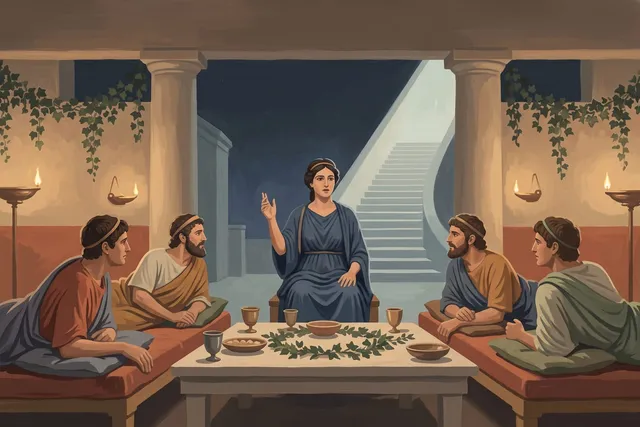
The occasion is historical: the young tragedian Agathon has just won first prize at the Lenaia festival, and a small circle gathers at his house to celebrate — the day after the big public party, which is why the guests, still fragile, agree to drink lightly and send the flute-girl away (176e). Their entertainment instead: each man, in turn, will make a speech in praise of Love, a god they agree has never been properly hymned (177a–d).
Plato wraps the evening in distance. We hear it from Apollodorus, who was not there, retelling what Aristodemus, who was, told him — years after the fact, and checked in part with Socrates (172a–174a). The party is already a legend being passed around Athens, and Plato lets us feel that we are receiving a famous night second-hand.
The guest list matters. Around the couches are a rhetoric enthusiast (Phaedrus), a legal mind (Pausanias), a doctor (Eryximachus), the comic playwright Aristophanes — in real life the man whose Clouds had mocked Socrates — the tragic playwright Agathon, and Socrates himself, who arrives late because he stopped in a neighbour’s porch to think (174d–175b). Tragedy, comedy, medicine, rhetoric, law and philosophy each get a voice.
Phaedrus: love makes us brave (178a–180b)
Phaedrus opens with the oldest claim: Love is among the most ancient of gods, and the greatest benefactor, because love is the strongest motive for honour. No one wants to look cowardly in front of their beloved; an army composed of lovers would conquer the world (178e–179a). His examples — Alcestis, who died for her husband; Achilles, who avenged his — set up love as the engine of noble action.
What he gets right, and misses: love does transform behaviour. But Phaedrus praises love’s effects without asking what love is — the question the dialogue is quietly assembling.
Pausanias: two loves, not one (180c–185c)
Pausanias makes the first real distinction. There is common love — aimed at bodies, indifferent to character — and heavenly love, aimed at mind and virtue (180d–181c). A relationship is honourable, he argues, when beauty is exchanged for wisdom: the beloved gratifies a lover who genuinely improves him.
What he gets right, and misses: the split between lower and higher love drives the rest of the dialogue, all the way up Diotima’s ladder. But in Pausanias’ hands it is also self-serving — an Athenian gentleman constructing rules under which his own conduct counts as the noble kind.
Eryximachus: love as cosmic harmony (185e–188e)
Aristophanes is due to speak next but is seized by hiccups — Plato’s joke arrives before his myth does — so the doctor Eryximachus swaps places with him and prescribes a cure (185c–e). His speech scales Pausanias up: love is not just a human matter but a principle of balance running through medicine, music, seasons and sacrifice. Health itself is good love among the elements of the body (186b–e).
What he gets right, and misses: love becomes a force in nature, not merely a feeling — a genuinely Platonic move. But the speech is pompous system-building, and Plato lets it sound that way.
Aristophanes: the missing half (189d–193d)
Cured of his hiccups, the comedian tells the dialogue’s most famous story. Humans were originally round beings with four arms, four legs and two faces; some were double-male, some double-female, some androgynous. They were strong enough to assault the gods, so Zeus sliced each one in two “like an apple” (190d–e). Ever since, every human is a half looking for its half; love is the name of that search, “the desire and pursuit of the whole” (192e). When two halves find each other, they cannot say what they want from each other — not sex exactly, but to be fused again, never to be parted (192c–d).
Every “other half” and “soulmate” in modern speech descends from this passage.
What he gets right, and misses: the story captures how love feels — like recognition, like incompleteness ended — better than any argument in the dialogue. Note the layered irony: Plato gives the deepest emotional truth to a comedian, the very one who had lampooned Socrates on the Athenian stage. And Diotima will later quietly reject the myth’s core: we do not seek our other half unless that half is good (205e). Love aims at the good, not merely at reunion.
Agathon: the beautiful speech about nothing (194e–197e)
The host speaks last among the ordinary guests, and gives the evening its most polished performance: Love is the youngest of the gods, tender, supple, beautiful, the source of every virtue. It is gorgeous, rhythmic — Agathon is a prize-winning stylist — and it is empty. He has described not love but an idealised beloved.
Why it matters: the speech is the perfect target. Socrates remarks that he cannot compete with a eulogy so beautiful it need not be true (198b–199a), and asks permission to do something different: ask what love actually is before praising it.
Socrates and Diotima: what love is (199c–212c)
Socrates first cross-examines Agathon into a corner with two observations: love is always love of something, and one desires what one lacks. So if Love desires beauty, Love is not beautiful (199c–201c). The entire praise-contest has been describing love’s objects, not love.
Then Socrates hands the stage to a woman: everything he knows about love, he says, he was taught by Diotima of Mantinea, a priestess (201d). Her teaching, reported by Socrates, is the philosophical centre of the dialogue:
- Love is a great spirit, a daimōn between mortal and divine — child of Resource and Poverty, always needy, always scheming, a lover of wisdom rather than a possessor of it (202d–204a).
- Love seeks to give birth in beauty (206b): in body, producing children; in soul, producing poems, laws and virtues. Love is a mortal creature’s reach for immortality (207a–209e).
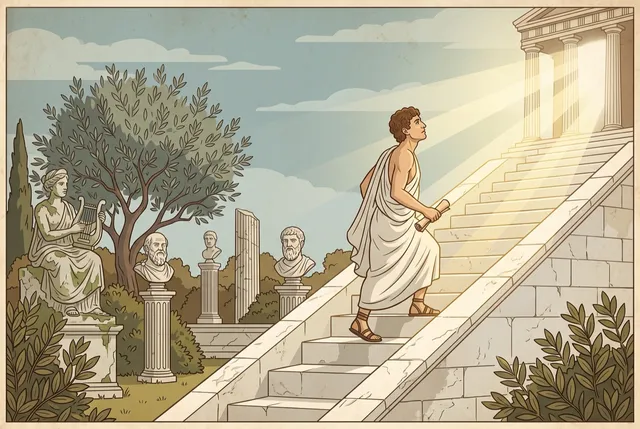
- Love can ascend. The ladder of love (210a–212a) climbs from one beautiful body, to all beautiful bodies, to beautiful souls, practices and knowledge, until the lover suddenly beholds Beauty itself — eternal, unmixed, unchanging — the Form that every beautiful thing shares in. Contemplating that, says Diotima, is the life most worth living (211d).
The full argument of the ladder, and what became of it in later centuries, is unpacked in the platonic love essay.
Alcibiades: the theory interrupted (215a–222b)
As Socrates finishes, the party is invaded. Alcibiades — brilliant, beautiful, and within a year of the dialogue’s date about to betray Athens — arrives very drunk, wearing a crown of ivy and violets. Told to make a speech, he refuses to praise Love and instead praises Socrates: a eulogy that is equal parts adoration and grievance.
He compares Socrates to a Silenus statue — comic and ugly outside, opening to reveal golden figures of the gods within (216d–217a) — and confesses that he once tried systematically to seduce him, ending with a night under the same cloak from which he rose untouched, “as if I had slept with my father or elder brother” (219c–d). Socrates, offered the most desired man in Athens, had remarked he was being offered “bronze for gold” (218e–219a).
The scene does two jobs at once. It shows Diotima’s teaching lived rather than lectured — desire acknowledged and mastered, not absent — and it is a portrait, drawn after both men were dead, of the one seduction Athens’ most dangerous man ever failed to complete.
How it ends (223b–d)
A second crowd of revellers bursts in, the disciplined drinking collapses, and the guests pass out one by one. At dawn only three are awake: Socrates, Agathon and Aristophanes, sharing a wine cup while Socrates forces the two playwrights to admit that a true master of tragedy should also be able to write comedy (223d). Then they too fade; Socrates tucks them in, walks to the Lyceum, spends the day as usual, and goes home in the evening.
It is a quiet joke with a point: the philosopher outlasts both tragedy and comedy — and the Symposium itself, which has been both, is Plato’s demonstration of the claim.
The speeches at a glance
| Speaker | Passage | Love is… |
|---|---|---|
| Phaedrus | 178a–180b | the oldest god; the motive for courage and honour |
| Pausanias | 180c–185c | two things: common (bodily) and heavenly (of the mind) |
| Eryximachus | 185e–188e | a cosmic principle of harmony and health |
| Aristophanes | 189d–193d | the search for our severed other half |
| Agathon | 194e–197e | young, beautiful, the source of all virtue |
| Socrates / Diotima | 199c–212c | a spirit between mortal and divine; desire ascending to Beauty itself |
| Alcibiades | 215a–222b | (praises Socrates instead — the theory embodied) |
Reading the Symposium today
Three things to hold onto. First, the structure is the argument: each speech is partial, and the dialogue’s form — voices correcting voices, the Socratic method dramatised — is Plato’s claim about how understanding is actually reached. Second, the Symposium is one panel of a diptych: the Phaedrus retells the ascent from inside a single soul, and the early Lysis shows Plato failing honestly at the neighbouring question of friendship. Third, the dialogue’s date is a dagger: within months of that evening, Alcibiades would be accused of profaning the mysteries and defect to Sparta, and several of the drinkers would be caught in the scandal. Plato’s first readers knew it. The loveliest night in his writing is set on the edge of a catastrophe, which is very much how Plato thought beauty in this world behaves.
Keep reading