Platonic Love: What Plato Actually Said in the Symposium
In short. Platonic love now means deep affection without sex. Plato meant almost the opposite: desire so strong it climbs from one beautiful body to Beauty itself. Here is the real theory, and how the phrase drifted.
Platonic love, in everyday English, means deep affection without sexual desire — the love between close friends. That meaning is real, it is nearly five hundred years old, and it is not what Plato said.
What Plato actually argued, mostly in the Symposium, is stranger and more ambitious. Love — erōs, which for the Greeks meant passionate, possessive desire, the kind that keeps you awake — is not something to be subtracted from a relationship. It is a force to be redirected: from one beautiful body, upward through beautiful souls, beautiful practices and beautiful ideas, until it reaches Beauty itself, the unchanging Form of which every beautiful thing is a passing image. Plato’s love is not desire minus sex. It is desire aimed at the one object that can actually satisfy it.
The gap between the modern phrase and the original theory is not a mistake to be corrected so much as a history to be told. Both halves are below: first what Plato said, then how “platonic” came to mean what it means now.
Where the theory lives: a drinking party in 416 BC
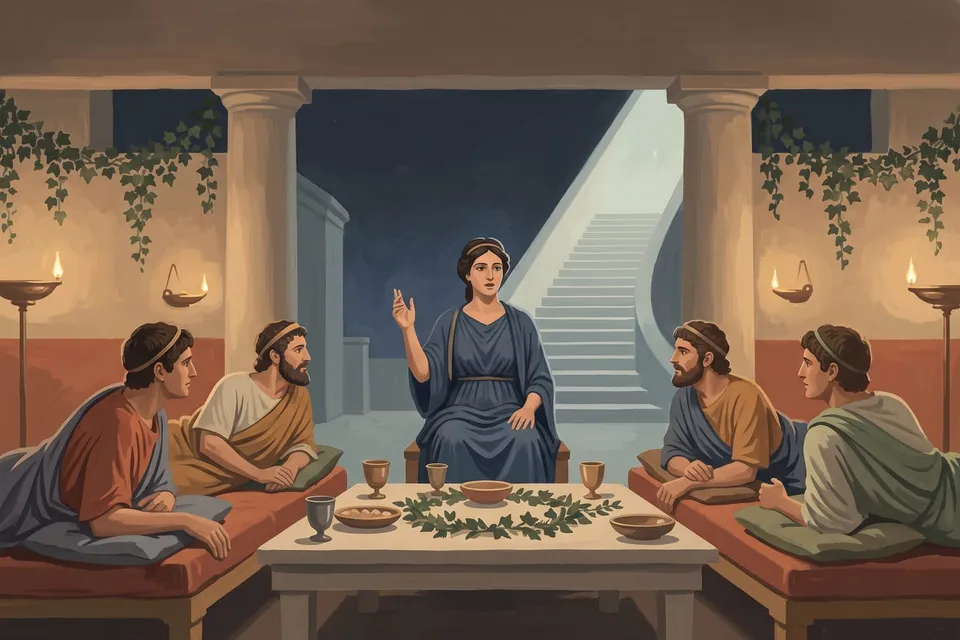
The Symposium is set at a party. The tragedian Agathon has just won first prize at the Lenaia festival, and the guests — hungover from celebrating the night before — agree to go easy on the wine and entertain themselves another way: each man will give a speech in praise of Love (176e–177d). A symposion was literally a “drinking together”, and Plato’s readers would have recognised the setting as one where talk about love was at home.
The dialogue reaches us at three removes: Apollodorus retells what Aristodemus, who was there, told him years earlier (172a–174a). Plato flags the distance deliberately. This is a famous evening, already half-legend by the time we hear it — and Plato, as he almost never does, stages a series of complete rival positions before letting Socrates speak.
Six speeches matter, and then an interruption that matters more.
The first five speeches: love praised, love misunderstood
Each speaker before Socrates gets something right, and each is corrected by what follows.
- Phaedrus (178a–180b) calls Love the oldest of the gods and the source of courage: an army of lovers would be unbeatable, because no one behaves shamefully in front of the person they love. Love as the motor of honour.
- Pausanias (180c–185c) splits Love in two: a “common” erōs aimed at bodies, and a “heavenly” erōs aimed at minds and character. The distinction between lower and higher love — the seed of everything that follows — enters the dialogue here, though Pausanias mostly uses it to dress up his own preferences.
- Eryximachus (185e–188e), a doctor, inflates love into a cosmic principle of harmony governing medicine, music and the weather. Pompous, but he makes love a force in nature rather than just a feeling.
- Aristophanes (189d–193d) tells the most famous story in the dialogue. Humans were once round, eight-limbed, two-faced creatures. They were powerful enough to threaten the gods, so Zeus cut them in half (190d–191a), and ever since, each of us has wandered the world searching for our missing half. Love is the name for that pursuit of wholeness — “the desire and pursuit of the whole” (192e). This is the origin of every “other half” and “soulmate” cliché in the language. Note what Plato does with it: he puts the most emotionally satisfying theory of love in the mouth of a comedian, and then has Socrates’ teacher quietly demolish it — we do not seek our other half, she says, unless that half is good (205e). Love aims at the good, not at completion for its own sake.
- Agathon (194e–197e) praises Love as young, beautiful, delicate and virtuous — a speech of gorgeous style and no content, which is exactly what Socrates needs.
Socrates and Diotima: what love actually is
Socrates begins by cross-examining Agathon (199c–201c) with a simple observation: love is love of something, and you desire what you lack. If Love desires beauty, Love cannot already be beautiful. In a few exchanges the whole praise-contest collapses: everyone has been describing the object of love while claiming to describe love itself.
Then Socrates does something he does nowhere else in Plato: he hands the argument to a woman. Everything he knows about love, he says, he learned from Diotima of Mantinea, a priestess (201d). Whether she is historical or Plato’s invention is still argued; either way, the core of the dialogue is a woman’s teaching, reported by Socrates.
Diotima’s account comes in three movements.
Love is between, not divine. Erōs is not a god but a daimōn, a great spirit halfway between mortal and immortal, ferrying messages between men and gods (202d–203a). His parents, in her myth, are Poros (Resource) and Penia (Poverty), which is why love is always both needy and inventive (203b–e). And because love desires wisdom without possessing it, the lover is by definition a philosophos — a wisdom-lover. Philosophy itself, on this account, is a form of love.
Love wants to give birth. What love ultimately seeks, Diotima argues, is not beauty as a possession but “giving birth in beauty” — tokos en kalōi (206b). All of us are pregnant, in body or in soul, and the presence of beauty is what lets us bring forth what we carry. Bodily lovers beget children; lovers pregnant in soul beget poems, ideas, laws, virtues — offspring, she notes, that outlive the other kind (209a–e). Love is the mortal creature’s strategy for immortality.
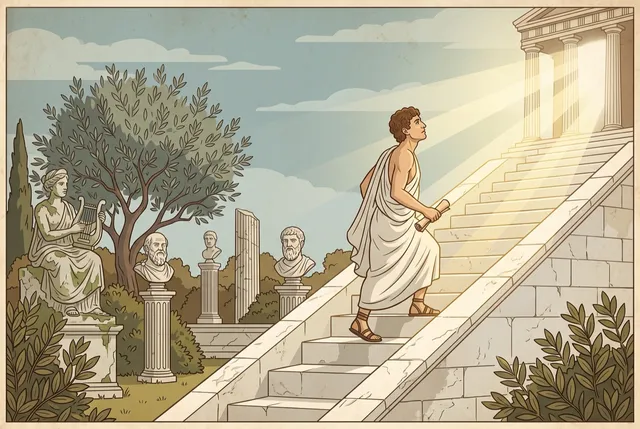
Love can climb. Then comes the passage the whole tradition hangs on: the ladder of love, or scala amoris (210a–212a). Guided rightly, a lover ascends:
- Love of one beautiful body — where everyone starts.
- Love of all beautiful bodies, once he sees that the beauty in any one body is “brother” to the beauty in every other, and that it is absurd to be enslaved to a single instance (210b).
- Love of beautiful souls, judged more valuable than bodies even in a plain-looking person (210b–c).
- Love of beautiful practices and laws — the beauty of how people live together.
- Love of beautiful knowledge — the sciences, the “great sea of beauty” (210d).
- Finally, the sudden sight (exaiphnēs, “all at once”, 210e) of Beauty itself: eternal, unchanging, “not beautiful in one respect and ugly in another”, not located in any body or any thing, but the single reality every beautiful thing shares in (211a–b).
At the top of the ladder, love has not been abandoned. It has arrived. A life spent contemplating Beauty itself, Diotima says, is the life most worth living for a human being (211d) — and only there does the lover touch not images of virtue but the real thing, and become, “if any human can”, immortal (212a).
Two details are routinely lost in summary. First, the lower rungs are not condemned; loving one beautiful body is the correct first step, not a sin. Second, in the strongest reading of 211b, the earlier loves are not discarded like a used ladder — they are seen for what they always were: partial appearances of the one thing the lover was reaching for all along.
Alcibiades: the theory made flesh
Just as the speeches end, the party is invaded. Alcibiades — the most glamorous, gifted and eventually treacherous man in Athens — arrives drunk, crowned in ivy and ribbons, and is asked to give his own praise of Love. He refuses. Instead he praises Socrates (215a).
His speech is a confession. Alcibiades, pursued by half of Athens, set out to seduce Socrates, certain his beauty would buy him the philosopher’s wisdom. He engineered wrestling sessions, private dinners, finally a night under the same cloak — and Socrates, who never pretended not to feel desire, declined the whole transaction, remarking that Alcibiades was proposing to trade “bronze for gold”: his body for something worth infinitely more (218e–219a). Alcibiades got up in the morning, he admits, as if he had slept beside his father or brother (219c–d). Socrates is like the statues of Silenus, he says, ugly clay figures that open to reveal gods inside (216d–217a).
This scene, more than Diotima’s ladder, is the historical seed of the phrase “platonic love”: a relationship where desire is present, acknowledged, and not acted on, because both parties — or at least one — are after something higher. Note what it is not: it is not an absence of erōs. Socrates is portrayed throughout as intensely susceptible to beauty. The restraint is the redirection Diotima taught, performed live.
The dialogue ends near dawn, with Socrates still sober, still arguing — forcing the exhausted tragedian and comedian to concede that one man should be able to write both tragedy and comedy (223d) — and then walking off to spend the day as usual.
The other half of the theory: the Phaedrus
The Symposium is not Plato’s only word on love. The Phaedrus gives the theory its psychology. There the soul is a chariot: a driver — reason — managing a noble white horse and an unruly dark one (246a–b, 253d–e). When the lover sees a beautiful face, the sight jolts the soul’s memory of the Beauty it saw before birth, the wings it lost begin to regrow, and the dark horse bolts toward the body while the driver hauls back (251a–254e). Plato’s lover is not serene. He is described as feverish, sleepless, half-mad — and this madness, Socrates insists, is a divine gift, not a disease (244a, 249d).
Crucially, the Phaedrus makes explicit what the Symposium implies: the best human love, for Plato, is between two people. The pair who master the dark horse live “a life of blessedness and harmony, self-controlled and orderly”, and grow wings together (256a–b). Even the pair who occasionally fail are treated gently. The struggle happens inside a soul with parts — the same tripartite structure argued for in the Republic — which is why Plato can say both that desire is essential and that it must not rule.
For love’s quieter cousin, friendship, Plato wrote a whole early dialogue, the Lysis — which ends, with disarming honesty, in admitted failure to define it.
How “platonic” came to mean “just friends”
The phrase is Renaissance, not ancient, and its history has three steps.
Ficino coins it. In 1469 the Florentine philosopher Marsilio Ficino, who had translated the complete Plato into Latin for the Medici, wrote a commentary on the Symposium (De amore) in which he named the love of one soul for another, grounded in the love of God, amor platonicus — “platonic love” — and paired it with amor socraticus, the chaste bond of Socrates and Alcibiades. For Ficino the term was still doing Diotima’s work: this love was a ladder to the divine, now in Christian dress. What changed in his hands was the emphasis — the bodily rung of the ladder became something to be left behind rather than climbed through, a spiritualising of erōs that Plato’s own text is more ambivalent about.
The court makes it fashionable. In the 1630s the phrase crossed into English through the court of Charles I, where Queen Henrietta Maria made a cult of refined, non-physical devotion between ladies and courtiers. William Davenant’s 1636 comedy The Platonick Lovers mocked the fashion, and the mockery stuck to the term: “platonic love” now meant a pointedly, sometimes preciously, sexless romance. Contemporaries were already joking that it was a polite fiction — which tells you the modern meaning, and the modern scepticism about it, arrived together.
Everyday English flattens it. From there the word slid from ideal to description. By the nineteenth century “platonic” no longer named a discipline of the soul; it named a category of relationship — affection without sex, then eventually any friendship at all. The ladder, the Forms, the pregnancy in beauty, the divine madness: all of it fell away, leaving only the absence that Alcibiades complained about.
So the drift, compressed: Plato — desire redirected upward to Beauty itself; Ficino — desire spiritualised into a path to God; the 1630s — desire renounced as courtly refinement; now — desire simply absent. Each step kept the previous step’s conclusion and dropped its reason.
Is the modern meaning wrong?
As a report of what Plato believed — yes, in three ways.
- Plato’s love is erōs, not its absence. A relationship with no desire in it is not higher on Plato’s ladder; it is not on the ladder. What he prized in Socrates was desire mastered, which presupposes desire.
- Plato’s love has a direction. Modern platonic friendship is horizontal — two people, sufficient to themselves. Diotima’s love is vertical: the beloved is loved as a bearer of beauty that points beyond both lovers. That is the theory’s power and its cost, and critics since Gregory Vlastos have pressed the cost: does the person on the first rung ever get loved as a person, or only as a rung? Defenders answer that seeing your love for one person as an instance of something universal need not diminish it — 211b says the higher vision lets you see the same beauty in the particulars, not instead of them.
- Plato’s love is rare and strenuous. The ascent is described as a guided discipline few complete. Applying the word to any comfortable friendship inverts the scale of effort involved.
But as English, the modern meaning is not a mistake — it is simply a different word now, with four centuries of its own history. And it preserves, faintly, something genuinely Platonic: the conviction that a bond between two people can be real, intense and valuable without being sexual, and that such a bond has a dignity of its own. Plato would want the rest of the theory back. He would not want the phrase abolished.
What “platonic love” means, then — twice over
In modern English: close affection between people who are not lovers; intimacy without sexual involvement.
In Plato: passionate desire (erōs), awakened by a beautiful person, understood as the soul’s reaching for immortality and for Beauty itself — a desire that should begin with one body, and must not end there.
The first definition is what the phrase means. The second is why the phrase exists.
Keep reading