Why Plato's Ideas Still Matter in the 21st Century
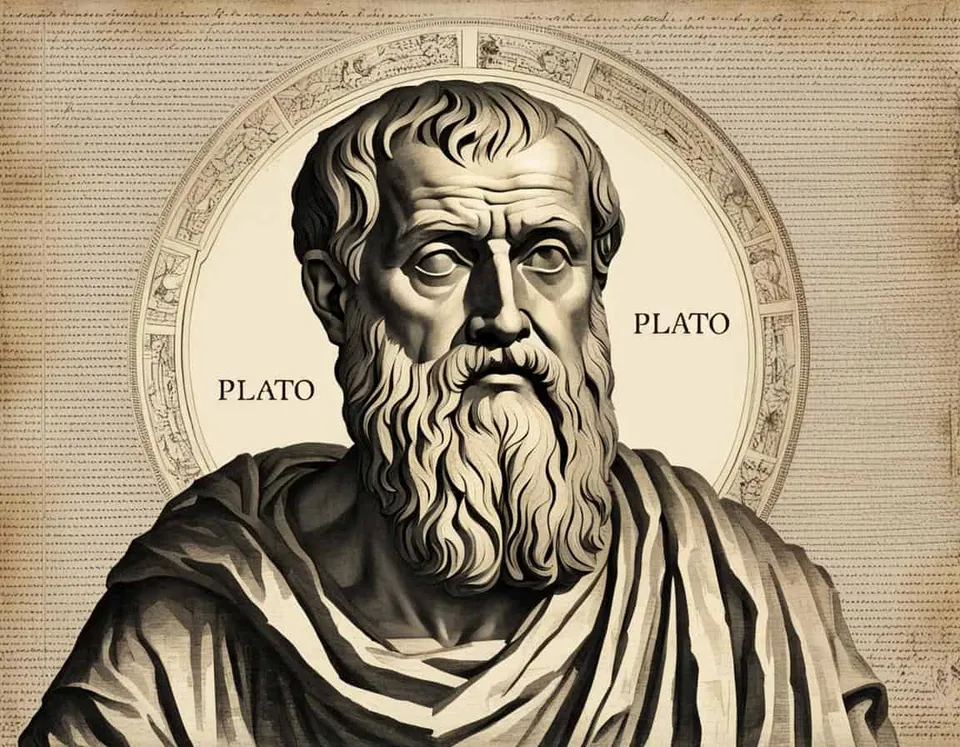
In short. Plato's ideas on truth, democracy, technology and the soul still frame live debates today, from social media and AI to demagogues, anonymity and equality.
Plato wrote his dialogues roughly 2,400 years ago, in a city-state of a few hundred thousand people that had no printing press, let alone a phone. Yet his questions keep resurfacing in places he never imagined: newsfeeds, classrooms, courtrooms, machine learning labs. That is because Plato was less interested in the furniture of Athenian life than in a small set of structural problems: how do you tell appearance from reality, what makes a society just, what turns a public into a tyranny, and what does a well-ordered mind look like. Those problems did not go away when the furniture changed.
This essay works through the specific places Plato’s ideas keep showing up now, with a link to a full essay on each. It also says plainly where Plato gets things wrong, because treating an ancient text as flawless is its own kind of shadow-watching.
Does the allegory of the cave describe life today?
In the Republic, Book 7, Plato describes prisoners chained since childhood, facing a wall, watching shadows cast by a fire behind them and mistaking the shadows for the whole of reality (Republic 514a–520a). One prisoner is dragged out, blinded by the sun, and has to relearn what is real before he can look at the sun itself, the source of everything he had mistaken for the world.
The image was built to describe education and philosophy, not screens. But it maps uncannily well onto a feed. A platform selects, ranks and repeats a narrow set of images and claims; a viewer who never steps outside that feed can mistake its shadows for the shape of the world. Our full guide to the allegory covers the fire, the puppet-handlers and the ascent to the sun in detail, and a companion essay applies it directly to algorithmic media, misinformation and the discomfort of leaving an echo chamber. The part of the allegory people often skip: the freed prisoner does not want to leave, and once outside, is not thanked for going back to tell the others.
What did Plato say about democracy and demagogues?
Plato was no democrat, and his critique of democracy in Republic Book 8 is one of his most argued-over passages. He describes a city that prizes freedom above everything else drifting toward disorder, officials barely obeyed, elders imitating the young to avoid seeming stern, and the city becoming ready to hand itself to whichever speaker flatters the crowd most skilfully, a path he traces to tyranny. Plato’s critique of democracy sets out the argument and its limits: Plato had just watched Athenian democracy execute Socrates, and his own alternative, rule by philosopher-kings, has never been tried and has obvious problems of its own. Even readers who reject that alternative often recognise the diagnosis. A public sphere that rewards flattery over expertise is vulnerable to demagogues, and that is a live worry in any media environment built to reward whatever gets the most attention.
What is the Ring of Gyges, and why does it matter for anonymity online?
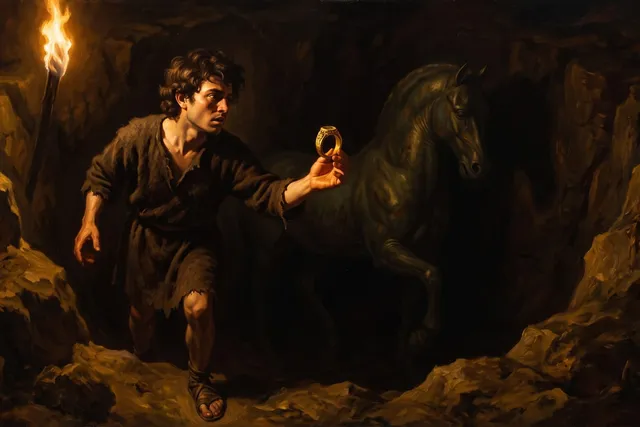
Early in the Republic, the character Glaucon tells a story: a shepherd named Gyges finds a ring that makes him invisible, and uses it to seduce a queen, murder a king and take his throne (Republic 359c–360d). Glaucon’s challenge to Socrates is blunt. If nobody could ever see what you did, would you still act justly, or does justice only survive because we are watched? What is the Ring of Gyges sets out Socrates’ answer, that injustice damages the unjust person’s own soul whether anyone is watching or not, and traces why the thought experiment resurfaces every time someone talks about anonymous accounts, disappearing messages or the different person people become behind a screen name.
What did Plato mean by education, and what is a Socratic seminar?
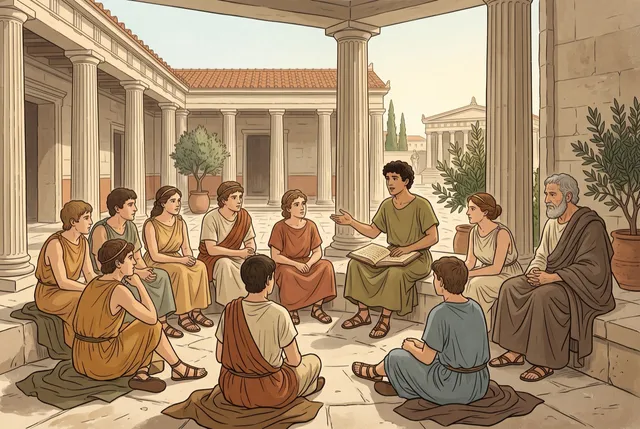
For Plato, education was not information transfer. In the cave allegory, turning toward the light is described as redirecting the whole soul, not pouring facts into an empty container (Republic 518b–d). The method he dramatises throughout the dialogues, questions that expose a gap between what someone claims to know and what they can actually defend, is the ancestor of the modern Socratic seminar, a classroom format built on student-led questioning rather than lecture. It is a small but real piece of Plato’s legacy: a teaching method more than two thousand years old, still assigned in schools because it still works.
Does Plato’s tripartite soul anticipate modern psychology?
In Republic Book 4, Plato divides the soul into three parts, reason, spirit (the seat of pride, anger and ambition) and appetite (bodily desire), and argues that a just person is one in whom reason rules with spirit’s backing, keeping appetite in check (Republic 434d–441c). The structural resemblance to Freud’s id, ego and superego is close enough that readers have noticed it for a century. Plato and Freud compared works through where the parallel holds and where it breaks down: Freud built his model from clinical observation of patients, Plato built his from an analogy with the three classes of his ideal city, and the two do not map onto each other exactly. But the basic intuition, that a mind is not one thing but a contest between reason, drive and desire, is one modern psychology never really abandoned.
What did Plato think of writing, and what does that mean for AI?
Near the end of the Phaedrus, Socrates tells a story about the Egyptian god Theuth offering writing to King Thamus as a gift for memory. Thamus refuses the compliment: writing, he says, will produce forgetfulness, because people will stop exercising their own memory and rely on external marks instead, and it will give the appearance of wisdom without the substance of it, since a written text cannot answer a question or defend itself the way a person can (Phaedrus 274c–277a). The paradox of writing in Plato’s Phaedrus traces the irony that Plato voiced this worry in writing, the only reason we have it at all, and shows how nearly the same argument gets reused today about calculators, search engines and now large language models: a new tool for offloading a cognitive task, and a new argument about what gets lost in the offloading.
What is a noble lie, and do we still use them?
In Republic Book 3, Socrates proposes a founding myth for his ideal city: a story telling citizens they were born from the earth with different metals, gold, silver, or bronze and iron, mixed into their souls, to explain and justify the city’s class structure (Republic 389b–d, 414b–415d). He calls it a useful falsehood told for the city’s benefit. What is a noble lie covers the passage and the long shadow it has cast: the phrase gets applied, often loosely, to any political myth, founding narrative or public deception justified as being for the greater good, and the essay is honest about how uneasy that idea is once you notice how often it gets invoked to defend manipulation rather than genuine civic myth-making.
Is mathematics real? Plato and mathematical Platonism
Plato’s theory of Forms holds that abstract objects, the Form of Justice, of Beauty, of a perfect circle, are more real than any physical thing that merely resembles them (Republic 509d–511e, the divided line). Few working mathematicians read the Republic, but plenty of them are, whether they use the word or not, mathematical Platonists: they talk about discovering theorems rather than inventing them, as though numbers and proofs exist independently of anyone thinking about them. What is idealism in Plato explains the theory of Forms and traces this modern afterlife of it, a live position in the philosophy of mathematics, not just a historical curiosity.
Were Plato’s views on women progressive?
In Republic Book 5, Plato argues that women in the guardian class should receive the same education, including physical and military training, as men, and should be eligible for the same public roles, on the grounds that the only relevant differences between the sexes are physical, not differences in the capacity for reason or virtue (Republic 451c–457b). For a fifth-century BC Athenian, in a city where citizen women could not vote, own significant property or appear in court on their own behalf, this was a startling claim. The role of women in Plato’s Republic sets out exactly how far the argument goes, and where it stops: Plato still assumes women are on average weaker than men at every pursuit, and the whole scheme survives only inside a state that has already abolished the private family for the guardian class. Call it progressive with real limits, not proto-feminism.
Where Plato’s ideas speak to a modern question
| Plato’s idea | The modern question it speaks to |
|---|---|
| The cave and the ascent to the sun | How do algorithms and media shape what we mistake for reality? |
| Democracy’s drift toward flattery and tyranny | Why do demagogues thrive in attention-driven public life? |
| The Ring of Gyges | Does anonymity change how people behave online? |
| Turning the soul, the Socratic method | Should education train judgement, or just transfer facts? |
| The tripartite soul | Is a mind one thing, or a contest between reason and drive? |
| The critique of writing in the Phaedrus | What do we lose when a new technology does our remembering? |
| The noble lie | When, if ever, is a founding myth or political story justified? |
| The Forms and mathematical objects | Do numbers and proofs exist, or do we invent them? |
| Women in the guardian class | How far did an ancient thinker get toward sex equality, and where did he stop? |
Where is Plato dated or troubling?
Plato is not a self-help author with nothing but wisdom to offer. His ideal city runs on slave labour, which he barely treats as a problem at all; our essay on Plato and slavery sets out how badly that contradiction sits alongside his talk of justice. He proposes state censorship of poetry and myth in Republic Books 2 and 3, on the grounds that stories shape character and the wrong stories corrupt it, an argument that has been used to justify censorship of every stripe since. And his rigid three-class structure, in which most people are assigned a station in life and expected to stay in it, sits badly with almost any modern idea of individual liberty or social mobility. Taking Plato seriously means reading past the parts that still work, not pretending the parts that do not work are absent.
Why does one ancient philosopher keep coming back?
The mathematician and philosopher Alfred North Whitehead put it starkly in 1929: “the safest general characterization of the European philosophical tradition is that it consists of a series of footnotes to Plato” (Process and Reality). That is an overstatement, and Whitehead meant it partly as one, but it points at something real. Plato was the first writer in the Western tradition to lay out, in a form still readable today, the basic questions every later thinker has had to answer one way or another: what is real, what is just, what is a good life, what can we actually know. Each generation answers them with its own tools, in his case Athenian democracy and rhetoric, in ours social media, artificial intelligence and mass surveillance, but the questions themselves have not been retired. That, more than any single doctrine, is why Plato’s ideas still matter.
Keep reading