The Appetitive Soul in Plato: Definition, Argument and Examples

In short. The appetitive soul is the desiring part of Plato's tripartite soul — hunger, thirst, sex and above all money. Here is how Plato argues for it, with examples.
The appetitive soul is the part of us that wants things — food, drink, sex, comfort and, above all, the money that buys them. In Plato’s Republic it is one of the three parts of the soul, alongside reason and spirit. Its Greek name is to epithymetikon (τὸ ἐπιθυμητικόν), from epithymia, “desire” or “craving”.
If you have arrived from a question phrased as _“the soul is composed of appetite, spirit and __”, the missing word is reason.
What follows is not only the definition. Plato does not simply assert that the soul has parts — he argues for it, and the argument is the interesting part.
How Plato proves the soul has parts
The case appears in Book IV of the Republic, and it begins from a principle Plato takes to be obvious (436b):
The same thing will not be willing to do or undergo opposites in the same part of itself, in relation to the same thing, at the same time.
One thing cannot both push and pull in the same respect at the same moment. So if we can find a case where a person clearly does both at once, the person must have more than one part.
Plato’s example is a thirsty man who refuses to drink (439c). Something in him urges him towards the water; something else holds him back. By the principle above, these cannot be the same thing. The urge is appetite. The restraint — which weighs consequences, calculates, and concludes the water is bad — is reason, to logistikon.
That gives two parts. The third takes more work.
Why three parts and not two
Reason and appetite could plausibly cover everything. Plato thinks not, and he makes the case with a story rather than an argument (439e–440a).
Leontius was walking up from the Piraeus when he saw corpses lying beside the executioner. He wanted to look. He was also disgusted with himself for wanting to. For a while he struggled and covered his eyes — then desire won, and he ran to the bodies, forced his eyes open and shouted at them:
Look for yourselves, you evil wretches, take your fill of the beautiful sight!
The point is what Leontius is angry at. He is furious with his own desire. That anger is not appetite, because it is fighting appetite. Nor is it quite reason, because it is hot, indignant, and arrives without calculating anything. It is spirit, to thymoeides: the part that feels shame and indignation, and wants to be honoured.
Spirit is reason’s natural ally. In a well-ordered person it enforces what reason decides. In a badly ordered one, appetite recruits it instead.
What the appetitive part actually wants
Most summaries stop at “bodily desires”, which undersells it. Plato’s fuller account is at 580d–581a: each part of the soul has its own object and its own pleasure. Reason loves learning. Spirit loves victory and honour. Appetite he calls philochrēmaton — money-loving.
That is sharper than it first appears. Appetite is not only hunger and thirst; it is the part that wants the general-purpose means to satisfy every hunger. Money is what appetite reaches for, because money buys whatever it happens to crave next. This is why Plato treats the acquisitive, profit-seeking character as appetite-ruled, not merely the glutton.
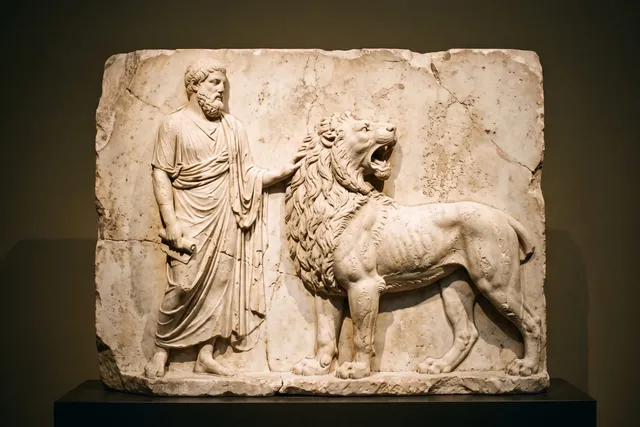
He gives appetite a memorable shape at 588c–e. Picture the soul as three creatures fused into one body: a many-headed beast, a lion, and a human being. The human is reason, the lion is spirit, and the many-headed beast is appetite — many-headed because our desires are numerous, mutually contradictory, and constantly sprouting new demands. You do not negotiate with one appetite. You negotiate with a crowd.
Necessary and unnecessary appetites
Plato does not treat appetite as simply bad. At 558d–559c he divides it in two:
- Necessary appetites are those we cannot get rid of, and whose satisfaction does us good — enough food to live, enough rest to function.
- Unnecessary appetites are those that can be trained away and that generally harm us: elaborate food beyond nourishment, luxury, the appetite for more once enough is had.
Plato returns to the question of which pleasures are actually worth having in the Philebus, where the answer turns out to be more generous than the Republic suggests.
That distinction carries real weight later. The decline from the timocratic to the oligarchic to the democratic to the tyrannical character in Books VIII and IX is essentially the story of unnecessary appetites taking more and more ground.
At the far end (571c–572b) Plato describes the lawless appetites that surface in dreams when reason is asleep — desires for any food, any act, any violence. Everyone has them, he says. What differs between people is whether they stay in the dream.
Examples of the appetitive part at work
- The thirsty man who does not drink (439c) — appetite pulling one way, reason another.
- Leontius and the corpses (439e) — appetite winning while spirit rages at it.
- Wanting a third slice while knowing you will regret it — necessary appetite already satisfied, unnecessary appetite still demanding.
- The accumulator who is not enjoying any of it — Plato’s philochrēmaton, chasing the means rather than any particular end.
- Waking ashamed of a dream (571c) — a lawless appetite that reason cages while awake.
The parallel with the city
Plato’s argument runs in both directions. The three parts of the soul answer to three classes in his city (434d–441c):
| Part of the soul | Class in the city | Virtue when it does its job |
|---|---|---|
| Reason — logistikon | Guardians | Wisdom |
| Spirit — thymoeides | Auxiliaries | Courage |
| Appetite — epithymetikon | Producers: farmers, craftsmen, traders | Moderation |
Appetite corresponds to the productive class, and that is not an insult — without it there is no city. Justice, for Plato, is each part doing its own work and not another’s. Appetite is not to be eliminated but governed. And it has to agree to be governed, which is what moderation means.
A common mix-up: the black horse is from a different dialogue
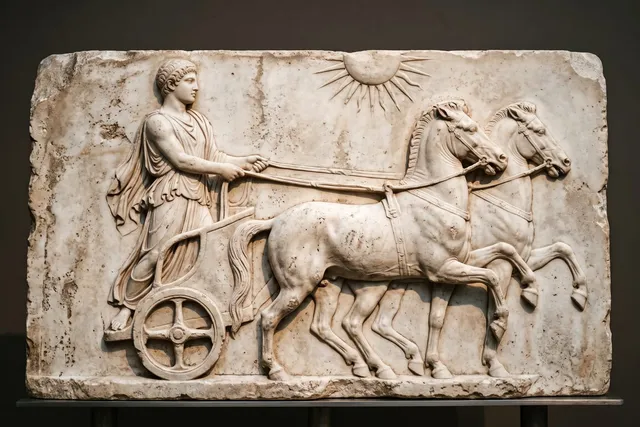
Many summaries of the appetitive soul reach for the image of a charioteer struggling with a white horse and an unruly black one. That image is real, but it is not from the Republic — it belongs to the myth of the soul in the Phaedrus (253d–254e), a different dialogue making a different argument about love and the soul’s ascent.
The two schemes rhyme: charioteer for reason, white horse for spirit, black horse for appetite. But the Phaedrus image is a myth about the soul’s flight and its fall into bodies, while the Republic’s tripartition is the conclusion of a formal argument about psychological conflict. Blending them muddles both. If the question is about the appetitive part of the soul, the Republic is the text.
Does it map onto Freud?
Loosely — and the comparison is worth making carefully. Freud’s id resembles appetite: unreasoning, insistent, pleasure-seeking. The superego shares something with spirit, in that it produces shame. The ego negotiates, as reason does.
But the fit is rough. Plato’s reason is not a mediator; it is meant to rule, and it has a desire of its own, the love of truth. Freud’s superego is internalised social prohibition, whereas Plato’s spirit is closer to a sense of one’s own honour — and it can be right when society is wrong. As an analogy it illuminates; as an equivalence it misleads.
Why the idea has lasted
The appetitive soul survives because the observation underneath it survives: we want things we do not want to want. Any account of self-control has to explain how that is possible without contradiction, and Plato’s answer — that the wanting and the not-wanting belong to different parts of us — is still the shape most explanations take, whether they are framed as parts of the soul, systems of the mind, or competing drives.
What Plato adds, and what modern retellings tend to drop, is that appetite has a legitimate claim. The just soul is not the one that has silenced the many-headed beast. It is the one where the beast is fed what it needs, and does not get to decide where the whole creature goes.
Keep reading